Most senders still try to fix sender reputation by watching bounce rates.
That’s no longer enough.
Mailbox providers now look at behavior: how consistently you send, how people engage, how often bad addresses appear, and whether your list quality is under control.
Bounce rate is only one visible symptom. The real issue is usually upstream: the quality of the email data you are sending to. That’s why inbox placement can still suffer even when your ESP dashboard looks acceptable.
To improve email deliverability, it’s important to understand how different parts work together. Long-term success depends on steady systems and processes. Deliverability follows a well thought-out campaign pre-send checklist.
Reputation isn’t a score. It’s a system.
For years, the answer to how to improve sender reputation lied in IP (or thereabouts). Warm the IP, avoid blocklists, and keep bounce rates low. Experts will tell you that view is that view is now inadequate.
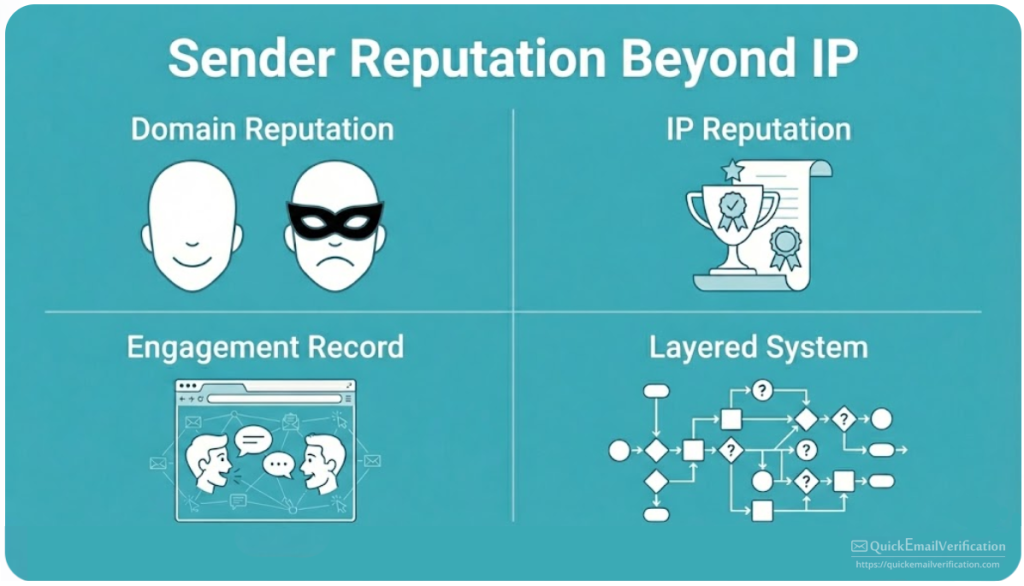
Modern mailbox providers look at reputation across several connected signals:
- Domain identity: Does the sender behave consistently over time, even when infrastructure changes?
- Authentication alignment: Do SPF, DKIM, and DMARC line up properly?
- IP history: Is the sending pattern stable and predictable?
- Engagement behavior: Are recipients opening, clicking, replying, ignoring, or complaining?
- Network environment: What kind of sending behavior exists around the sender?
No single signal tells the full story. A clean IP cannot protect a weak domain, good engagement cannot cancel out poor list quality, and authentication helps only when you’ve aligned everything.
The system looks at the whole picture.
That is also why major providers have become more explicit about sender requirements. Google’s bulk sender rules now expect SPF, DKIM, DMARC alignment, one-click unsubscribe, and spam complaint rates below 0.3%. Once email senders thought it was a great practice to follow; now it’s part of the baseline.
Domain reputation now outweighs IP reputation
This is the shift most senders haven’t fully understood (or accepted).
Domains are persistent identity. IPs are interchangeable infrastructure. When you switch ESPs, change sending platforms, or rotate IP ranges, your domain goes with you. Mailbox providers can track behavior over time even when the underlying infrastructure changes.
Authentication is what makes that identity legible. SPF, DKIM, and DMARC alignment shows control and policy discipline. When domain signals stay steady across IP ranges, it increases trust.
When alignment breaks or patterns shift often, the associated risk increases. And it wouldn’t help if you simply rotate IPs, because the system grades your domain.
In modern systems, the domain carries more weight than the IP. The IP still matters as a historical baseline, but it’s no longer the primary signal.
What hard bounces actually say about you
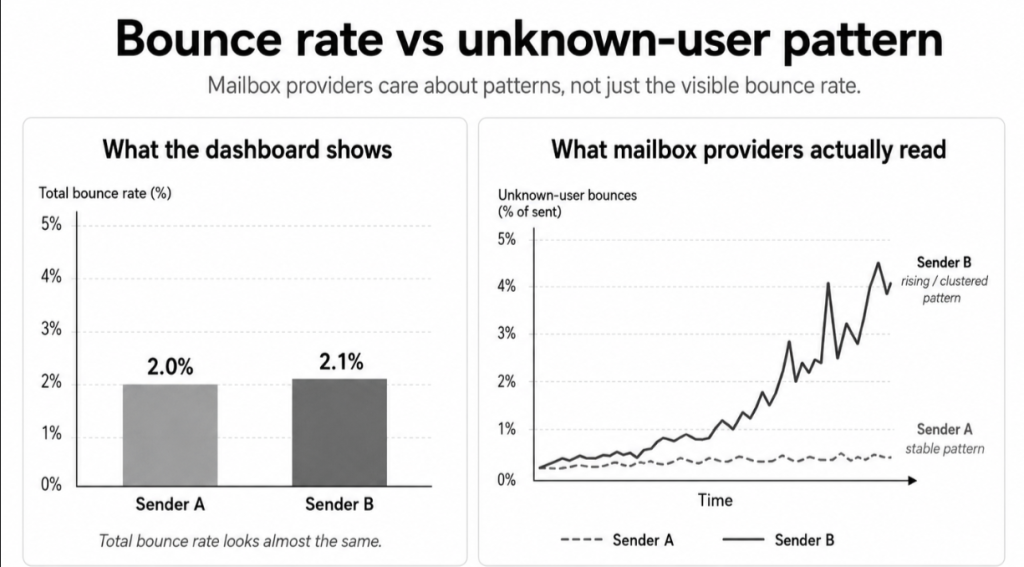
Hard bounces usually appear as one number on your ESP dashboard. But mailbox providers are not just looking at that number. They are looking at what the bounces say about your list quality and sending behavior.
A hard bounce is not just a failed delivery. It can signal poor data collection, weak list hygiene, or lack of control over where addresses are coming from.
Filtering systems do not react to one bad address. They look at patterns over time: what type of bounces are happening, how often they happen, where they appear, and whether there are sudden changes.
Mailbox doesn’t exist
The most serious hard bounce is the “unknown user” bounce, which means the mailbox does not exist.
A few unknown users in an older list can happen naturally. People change jobs, abandon accounts, or domains shut down. But a large number of unknown users in a newly added segment is a much bigger warning sign. It often violates good email collection practices. It points to outdated information, third-party data, or purchased lists.
Unknown-user trends matter because they raise a direct question: how did this sender get these email addresses?
What are the limits?
There is no public bounce-rate limit that applies to every sender. Mailbox providers look at context.
A sender with a long, stable history may be able to absorb small fluctuations. A sender with unstable metrics has much less room for error. One short spike may trigger closer review. A repeated pattern can damage reputation in ways that take much longer to repair.
How bounces are treated
Not all bounce spikes are treated the same way. A brief increase caused by a list upload mistake may settle once corrected. But a slow, steady rise in unknown-user bounces points to weak list management.
That pattern is more serious than the rate alone suggests.
In practice, consistency matters. Stable senders show small movements over time. Large swings create doubt, especially when the increase comes from unknown users.
Unknown-user tolerance: the hidden trigger
Repeated unknown-user bounces are a strong negative signal because they raise one simple question: How did this sender get these email addresses?
Mailbox providers don’t treat every unknown-user bounce the same way. They look at where the bounces are coming from and how the pattern behaves.
- New data: A small number of unknown users can happen. If you control the volume and engagement improves, the risk is usually lower.
- Aging lists: Email addresses go bad over time. If unknown-user bounces keep increasing slowly, it suggests the list is not being cleaned regularly.
- Purchased or scraped lists: Unknown-user bounces usually appear quickly and in larger numbers. Engagement is often weak, and sending volume may rise too fast. This creates a much stronger risk signal.
The point is simple: unknown-user bounces are hard to explain away. A mailbox either exists or it doesn’t. As these bounces increase, trust drops, and the sender gets less room for future mistakes.
Clustering: you’re not judged alone
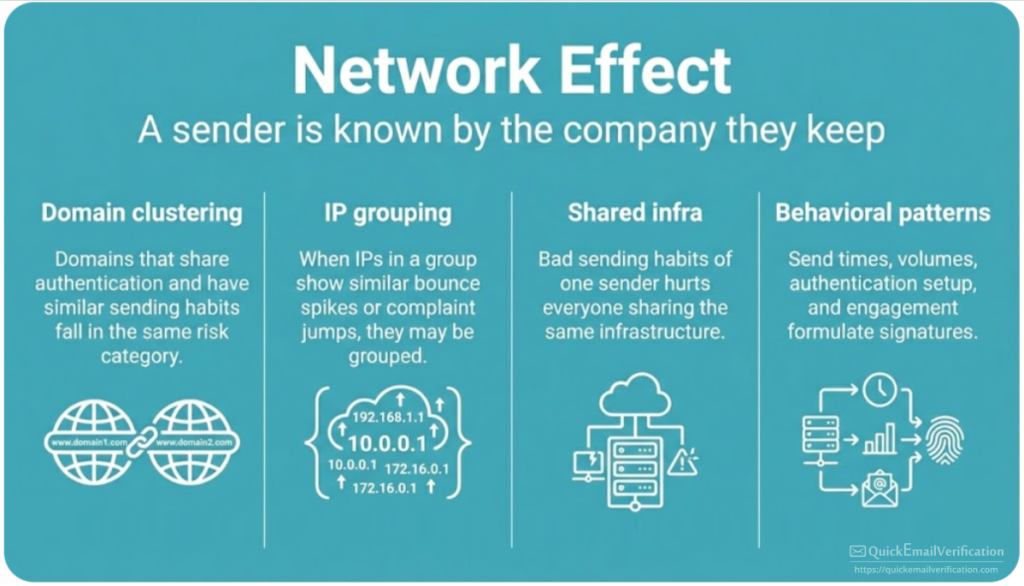
Modern filtering systems do not judge every sender in isolation. They look for patterns and group similar senders together.
That means your reputation is not shaped only by your own domain or your own IP. The systems, networks, and your sending behavior all impact it.
- Domains: Domains that use the same authentication setup, sending systems, content patterns, or infrastructure may be grouped together. If related domains follow strong practices, it can build trust. If one domain shows risky behavior, it can affect the others too.
- IP ranges: IP reputation is often judged at the range level, not just by one IP address. If several IPs in the same range show similar bounce or complaint patterns, mailbox providers may treat them as connected. This is why simply rotating IPs does not solve a reputation problem.
- Shared infrastructure: Shared hosting, ESPs, and cloud sending platforms add another layer. If the same environment regularly sends risky email, other senders using that environment may face more scrutiny too.
- Behavioral patterns: Send times, sending volume, authentication setup, headers, and engagement signals can create a recognizable pattern. If two senders look separate but behave the same way, filtering systems may connect them.
The simple point: mailbox providers judge the full sending system, not just one sender. Your reputation depends on your own behavior, but also on the wider environment you send from.
Engagement: the multiplier on every other signal
Engagement is not the foundation of sender reputation. It is more like a multiplier.
Once you figure out how to improve email engagement, mailbox providers may become more forgiving of small issues. When engagement is weak, the same issues can look more serious.
Three engagement patterns matter most:
- Engagement decay: New lists often perform well at first. Over time, opens, clicks, and replies usually slow down. That is normal. The risk is a sharp drop, especially when the list is not being cleaned or segmented properly.
- List age: Older lists often contain inactive addresses, people who changed jobs, abandoned mailboxes, and accounts that no longer show interest. These addresses may not bounce, but they add very little positive signal.
- Reactivation campaigns: A careful reactivation campaign can help recover some inactive users. But sending broadly to old or cold segments can create more complaints, more ignores, and weaker engagement.
Low engagement usually does not damage reputation on its own. The bigger problem is when low engagement appears along with other issues, such as rising unknown-user bounces, sudden volume increases, or more complaints from older segments.
Engagement cannot fix poor data quality. Strong opens do not mean every address on the list is safe. But steady, healthy engagement helps mailbox providers read the rest of your signals more positively.
What’s changed in the last few years
Filtering hasn’t just become stricter. It’s different now.
- Bulk sender rules are now enforced: At higher sending volumes, authentication, complaint handling, and one-click unsubscribe are no longer just best practices. They are expected.
- Authentication is now the baseline: SPF, DKIM, and DMARC alignment are no longer optional. Misalignment may not always lead to rejection, but it can reduce trust.
- Spam complaint tolerance is lower: Complaint rates that may have been ignored earlier can now affect reputation faster. Google’s 0.3% complaint-rate threshold is one example. Other providers use their own internal limits.
- Filtering is more behavior-driven: Mailbox providers look at patterns over time. They compare your current behavior with your own history and with similar senders.
- AI makes small changes easier to detect: Filtering systems can now spot shifts in bounce types, engagement, sending rhythm, and list quality that older rule-based systems may have missed.
The main change is this: following the rules is necessary, but it is not enough. Mailbox providers now reward senders who are steady, predictable, and consistent over time.
Where data quality fits in this system
Almost every reputation signal starts with one thing: the quality of the email addresses on your list.
You cannot improve engagement with contacts who no longer use that inbox. You cannot reduce unknown-user bounces if you haven’t cleaned the list. And you cannot keep sending patterns stable if a large part of the list is quietly creating risk.
This is where many senders get surprised.
Across the lists we verify at QuickEmailVerification, the “valid” rate is usually 79 – 90%. But the safe-to-send rate is often only 46 – 67%.
That gap matters.
Some addresses may look valid because they do not bounce right away. But they can still hurt your reputation. That’s because these emails
- may belong to inactive users,
- could be connected to domains that accept mail but rarely deliver it well, or
- may be old work addresses that technically exist, but no longer reach the right person
This is where reputation slowly gets damaged: not from one obvious failure, but from many weak signals adding up over time. The gap between what looks acceptable and what is actually safe is exactly where mailbox providers are now paying attention.
Verification does not replace authentication, engagement hygiene, or careful sending volume. But it gives those systems a cleaner base to work from.
Clean the data first, and the rest of your deliverability work has something stable to build on.
The takeaway
Sender reputation is not a score you fix once. It is a system that judges your sending behavior over time. Mailbox providers care less about what you intended to do and more about how steady and trustworthy your sending looks.
You cannot fix reputation with one list cleaning, one authentication update, or one tool. But you can reduce the noise that makes every other signal look worse. The biggest and most controllable source of that noise is usually poor data quality.
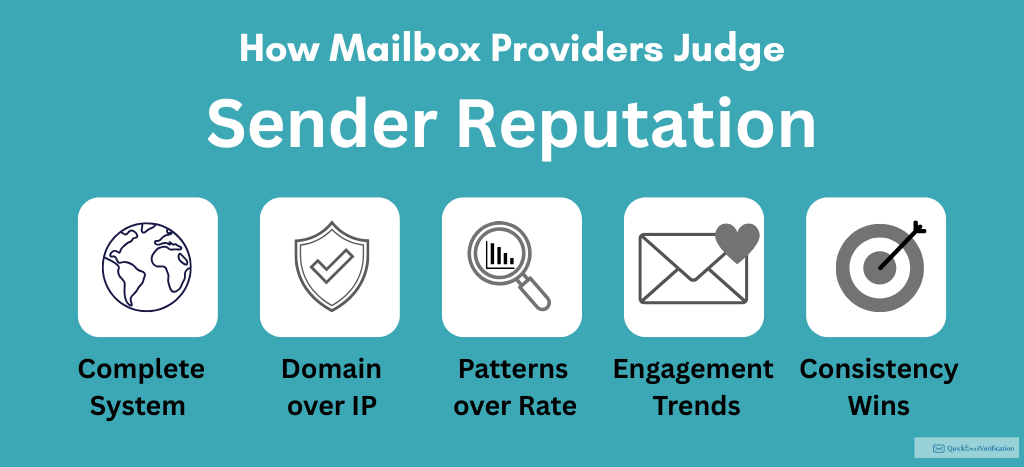
Five points matter most:
- Mailbox providers do not judge isolated metrics: They look at behavior across domain identity, infrastructure, engagement, complaints, bounce patterns, and other risk signals.
- Domain reputation now matters more than IP reputation: IP history still matters, but your domain is the identity that follows you across platforms, ESPs, and infrastructure changes.
- Unknown-user patterns matter more than the bounce rate alone: A stable bounce rate is very different from a sudden rise, a cluster of failures, or a steady increase in unknown-user bounces.
- Engagement is a multiplier, not a cure: Strong engagement can help other signals look better, but it cannot fix poor list quality or invalid addresses.
- Consistency is the real strategy: Modern filtering is behavior-driven. The safest senders are steady, predictable, and disciplined over time. There is no shortcut.
See where your list actually stands
QEV’s SafeToSend Score takes a list and shows you the same gap mailbox providers are grading: what looks valid versus what’s actually low-risk to send. Upload up to 3,000 emails free, no credit card.

The average score across the lists we verify is 62/100. Top quartile is 80+. Most senders are surprised by their number.