Fake and mistyped email addresses rarely trigger alarms. They enter CRMs quietly. They move through funnels unnoticed. Sadly, the damage appears later, when revenue numbers stop making sense. By then, you’ve already missed opportunities, wasted lots of resources, and lost serious business revenue.
What looks like a small data issue often can grow into a serious growth challenge for the organization.
In this guide, we begin by analyzing why fake emails enter CRMs. Next, we show how they hurt revenue across marketing and sales. Finally, we explain the practical steps you can take to actually stop emails from getting into your CRM.
Why fake emails enter CRMs even in mature funnels
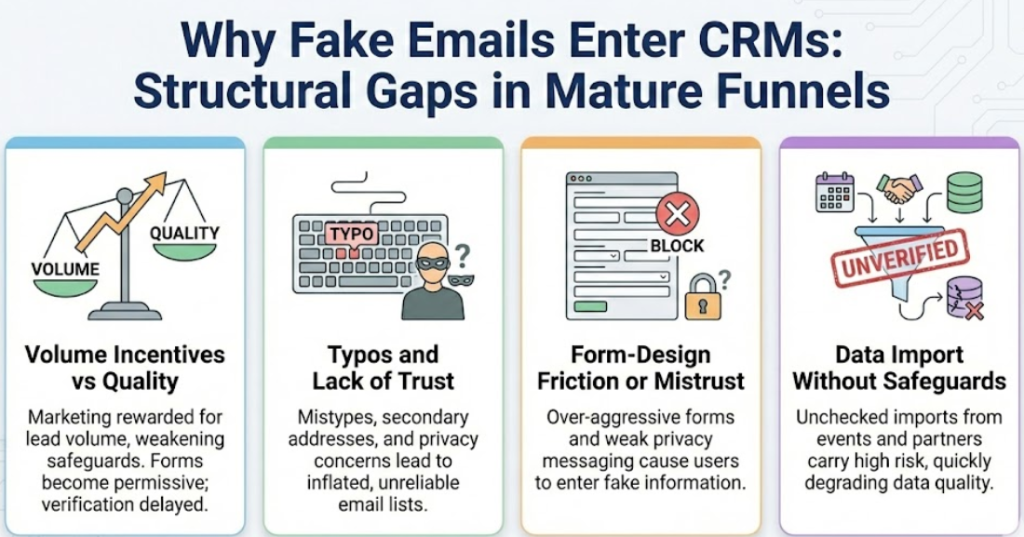
Bad email data is rarely caused by negligence. It usually comes from structural gaps that widen as teams scale. Here are some reasons how fake emails enter your CRM and pollute it.
Volume incentives vs quality
Marketing teams are often rewarded for lead volume. Because quantity is a priority over quality, safeguards weaken. Forms become permissive. Validation is delayed. Errors are accepted as normal.
Result: More leads on paper, but less revenue in practice.
Typos and lack of trust
People mistype emails. Others use secondary or throwaway addresses to protect their primary inbox. Some avoid giving real contact details until trust is established.
Result: You get an inflated email list list.
Form-design friction or mistrust
Some forms are over aggressive and require visitors to fill up too many fields. Other times, the privacy messaging isn’t strong enough, leading to lack of trust. Consequently, users enter fake information just to get past the gate.
Result: Low-trust experiences produce low-quality data.
Data import without safeguards
Event lists, partner leads, outbound lists, and legacy databases often enter CRMs without verification. These imports carry high risk and degrade data quality quickly if left unchecked.
Result: Your email data becomes unreliable.
The hidden revenue cost of bad email data
Most teams underestimate the cost of fake or invalid email addresses because the impact is spread across multiple systems.
Paid campaigns look less efficient. Sales teams chase leads that never respond. Deliverability slowly declines. Attribution reports become unreliable. None of these failures point directly to email quality, but they often start there.
As discussed below, bad email data hurts revenue in four ways.
1) It raises customer acquisition cost
Every fake email captured through paid traffic increases costs without increasing opportunity. You pay for the click, process the lead, and route it through systems, only to discover there is no real buyer behind it.
Over time, this pushes CAC up while the conversion rates drop.
2) It distorts lead scoring and attribution
When invalid or disposable emails enter your CRM, they still trigger events. Opens, clicks, and inactivity all get recorded, but the data does not represent real buyer intent.
This skews lead scoring and makes it harder to see which channels truly drive revenue.

3) It increases platform and storage costs
CRMs and ESPs price based on volume. Bad contacts inflate lists, push accounts into higher pricing tiers, and raise storage costs without adding value.
4) It wastes sales and marketing time
Sales teams follow up repeatedly on leads that never reply. Marketing teams troubleshoot campaigns that underperform for unclear reasons. Teams lose valuable hours chasing leads that were never real.
The revenue-protecting framework to stop bad emails
To prevent revenue loss, email quality must be treated as a system, not a one-time tool. This is where a structured approach matters.
The below framework focuses on protecting revenue at every stage of email capture and usage. We’ve called it the Revenue Integrity Framework.
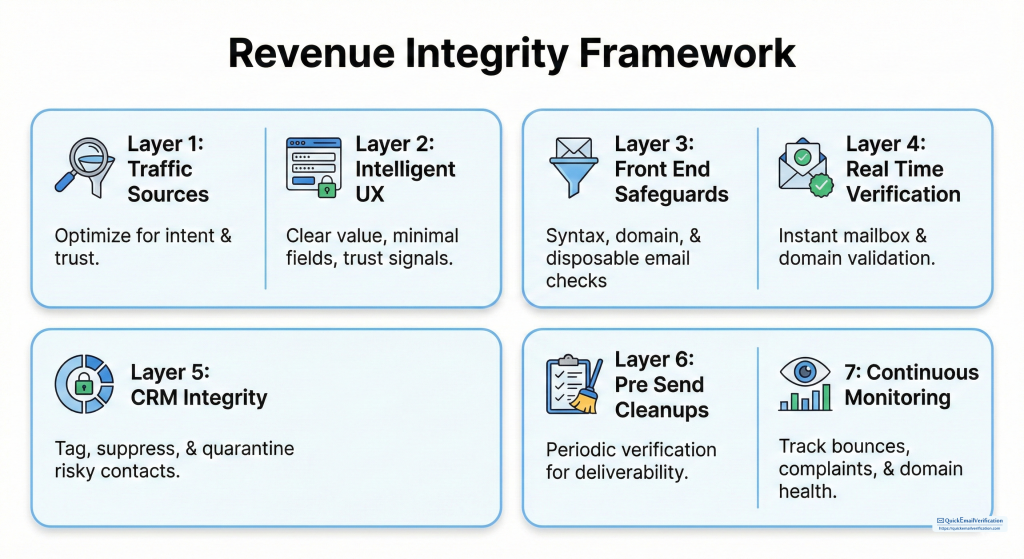
Layer 1: Quality starts with traffic sources
Different kinds of traffic produce different qualities of leads. Channels optimized only for volume tend to attract low-intent users and disposable emails.
High-quality traffic is aligned with clear intent, relevance, and trust.
For a deeper breakdown of safe acquisition practices, see this guide on building a safe email acquisition funnel.
Layer 2: Intelligent UX encourages honest input
Good form design reduces the incentive to fake data. Clear value exchange, minimal required fields, and visible trust signals improve accuracy without hurting conversion rates.

Layer 3: Front end safeguards filter obvious risks
Basic checks catch a large percentage of bad emails before submission. Syntax validation, domain checks, role address detection, and known disposable domain filtering eliminate low-quality entries early.
This layer removes noise before it spreads.
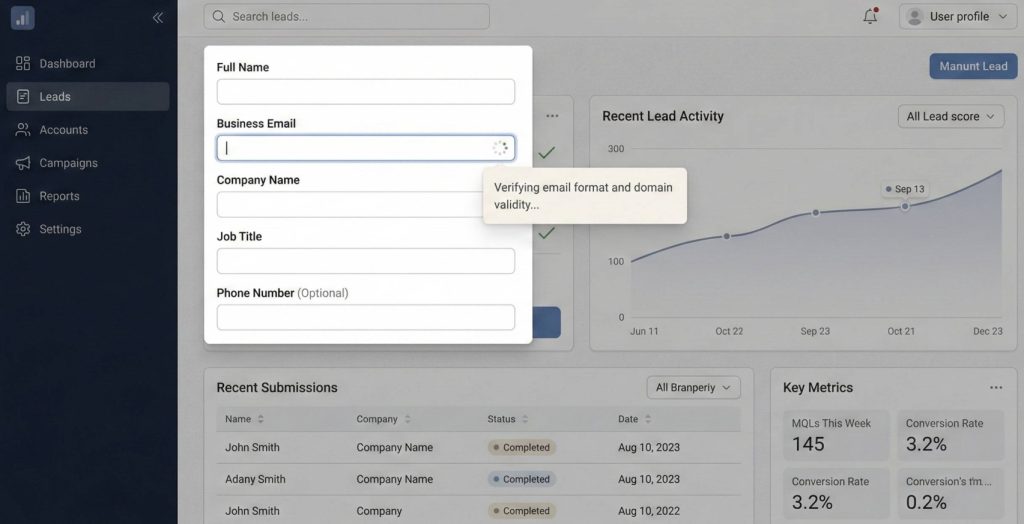
Layer 4: Real time verification blocks bad data at entry
Real time email verification checks mailbox existence and domain behavior before data is stored. Invalid, risky, or unreachable emails are rejected instantly.
This is the most cost-effective point to stop bad data because it prevents downstream waste entirely.
Layer 5: CRM integrity guardrails contain damage
Not every risky email needs to be deleted. Smart tagging, suppression, and quarantine rules keep questionable contacts from triggering workflows, routing to sales, or affecting metrics.

Layer 6: Pre send cleanups protect deliverability
Even valid emails decay over time. Periodic verification removes dormant, risky, or invalid addresses before campaigns go out.
This improves inbox placement and sender reputation. Learn more about how sender reputation impacts deliverability
Layer 7: Continuous monitoring prevents slow decay
Bounce rates, complaint trends, and domain-level issues should be monitored continuously. This prevents small issues from turning into systemic deliverability problems.
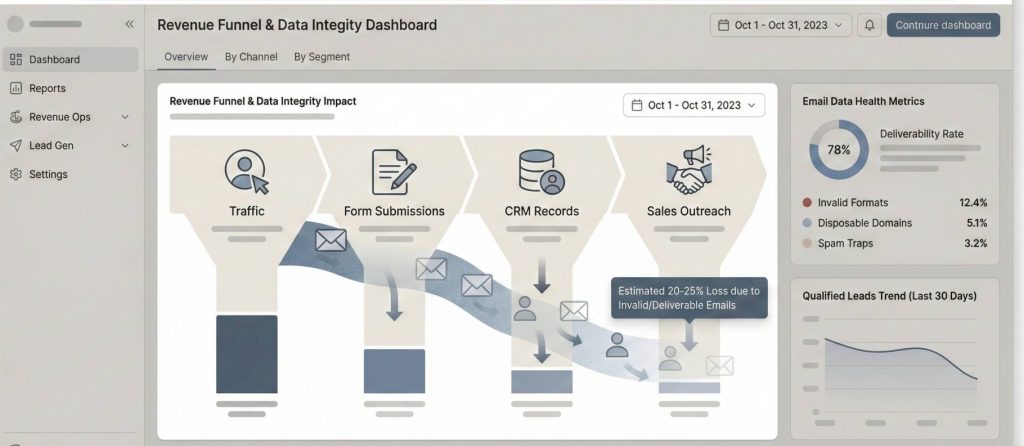
Which funnels lose the most money from bad emails
Some funnels are more vulnerable than others.
Paid traffic landing pages
High volume and low intent make paid traffic a prime source of fake and mistyped emails. Without real time verification, ad spend is quickly wasted.
Gated content downloads
Ebooks and reports attract users who want access, not engagement. Disposable and secondary emails are common here, especially without verification.
For deeper insight into risky email types, see this guide on catch all email addresses and deliverability.
Webinar registrations
Webinars generate large volumes of leads, but attendance rates are often low. Many registrations never represent real prospects.
Sales driven imports
Outbound lists and event data frequently include stale or recycled emails. Without validation, these lists damage deliverability and waste sales effort.
Why email verification is cost effective
Email verification is often seen as an added cost. In reality, it prevents much larger losses.
| Scenario | Without verification | With verification |
| Paid leads processed | 10,000 | 10,000 |
| Invalid emails | 12 percent | 1 percent or less |
| Sales follow ups wasted | High | Minimal |
| SP and CRM costs | Inflated | Controlled |
| Revenue attribution | Distorted | Reliable |
The cost of verification is small compared to the cumulative waste it prevents.
Practical fixes you can deploy this week
You do not need a full rebuild to improve results.
Start with these steps.
- Add typo correction and domain suggestions at form entry
- Reject disposable and high-risk domains in real time
Next, focus on processes.
In case you’re using paid leads, validate them before routing to sales. Apply CRM rules that prevent risky contacts from triggering workflows. Clean active sending lists before major campaigns.
And if you’re sending a campaign to a list that you haven’t used in the past 3 months, email verification is strongly recommended for that list.
Clean data is a revenue strategy not a hygiene task
Bad email data signs of failure that aren’t immediately visible. It lowers performance silently.
Teams that treat email quality as a revenue lever, not a maintenance chore, get much more out of their email list. They get clearer attribution and lower CAC. Their email deliverability rate is higher and experience a higher sales efficiency.
When bad emails are stopped at the source and monitored over time, growth becomes more predictable and revenue is easier to protect.
Frequently asked questions (FAQs)
1. What is a post-purchase email sequence?
A post-purchase email sequence is a structured series of automated emails sent after a customer completes a purchase. These emails reassure the buyer, provide guidance, request feedback, and introduce relevant follow-up offers at the right time.
2. How many post-purchase emails should you send?
Most businesses use between five and seven post-purchase emails, depending on their product type and sales cycle. The key is to align each email with a specific stage in the customer journey rather than sending messages too frequently.
3. When should post-purchase emails be sent?
Timing depends on the purpose of the email. Order confirmations are sent immediately, shipping updates when the product is dispatched, onboarding emails within a few days, and review requests after the customer has had enough time to use the product.
4. Do post-purchase emails increase customer retention?
Yes. A well-designed post-purchase email sequence improves customer retention by helping buyers get value from their purchase, reducing uncertainty, and maintaining engagement beyond the initial transaction.